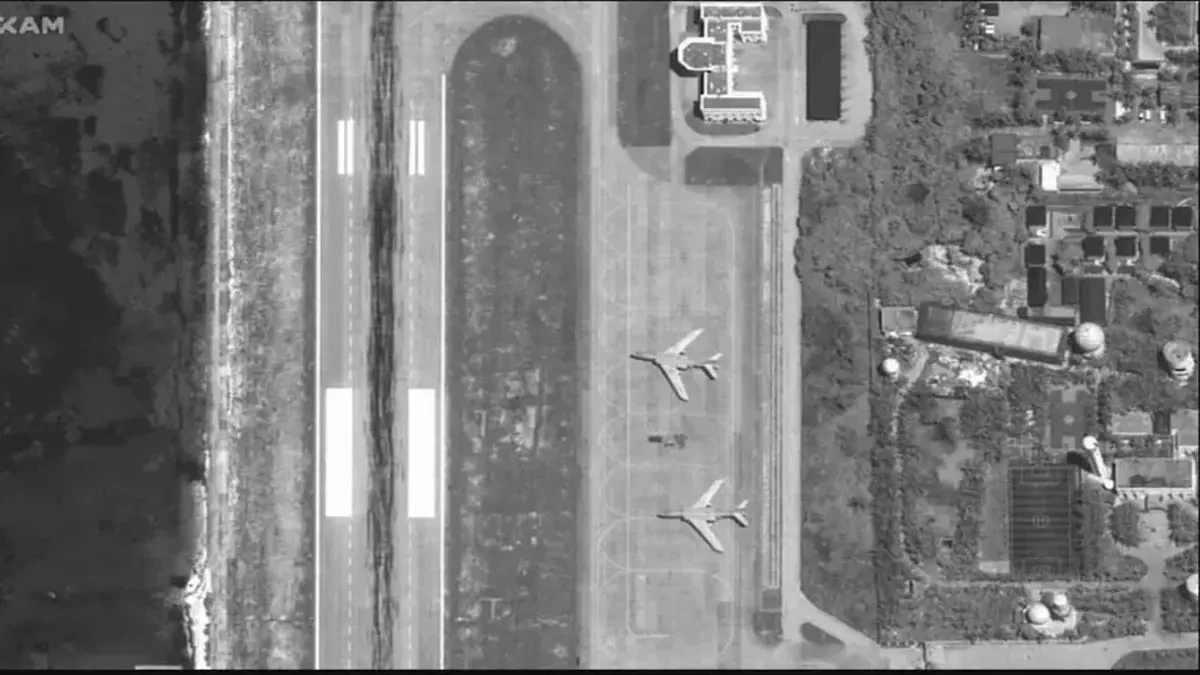
Satellite imagery and assessments by the Asia Maritime Transparency Initiative (AMTI) at the Center for Strategic and International Studies (CSIS) confirm that China now maintains 27 militarized outposts across the Paracel and Spratly archipelagos. Among these facilities, four have been identified as fully operational air and naval bases with 3,000‑metre runways, fighter jet hangars, surface‑to‑air missile sites, anti-ship cruise missile batteries, and advanced radar installations covering expansive zones of the South China Sea.
Nuclear-Capable Bomber Deployments
In May 2025, satellite imagery captured the deployment of two modernized H‑6K bombers—capable of carrying nuclear and conventional cruise missiles—on Woody Island, one of China’s Paracel bases. The aircraft were accompanied by Y‑20 transporters and a KJ‑500 early-warning aircraft, indicating integrated combat-readiness architecture. Analysts report that three bases in the Spratly chain, in addition to Paracel, are now capable of routinely hosting such long-range strategic bombers.
- (Maxar Technologies)
Operational Capabilities and Regional Reach
According to CSIS Director Gregory Poling, these island installations form “”the quickest example of mass dredging and landfill in human history,”” offering Beijing sustained ISR coverage, forward basing of fighter and bomber aircraft, and long-range strike potential that now extends within reach of Australian territory. AMTI analysis indicates that collective infrastructure—including hangars, runways, missile shelters, and sensing arrays—effectively enables PLA forces to oversee and control vast segments of regional airspace and waters.
Regional and Global Implications
- Strategic Deterrent and Power Projection: The expanded presence enables China to conduct longer-range air operations, intelligence gathering, and power projection well beyond its coastline.
- Challenge to Freedom of Navigation: The facilities’ density and capabilities threaten U.S. naval and aerial operations across key maritime routes, potentially altering Indo-Pacific force posture.
- Escalation Risks: The ability to deploy nuclear-capable aircraft within contested waters adds a new dimension to escalation management and regional deterrence dynamics.

- Mischief Reef (Meiji Reef) is a low-tide atoll in the eastern Spratly Islands, 239 km west of the Philippines’ Palawan Island. Controlled by China, it has been transformed into a military outpost with a large harbor, 2,644-meter runway, anti-aircraft weapons, and radar installations. Development began before 2016 and has steadily expanded. (Tony Peters/Wikimedia)
International Responses
At the Shangri-La Dialogue, U.S. Defense Secretary Pete Hegseth described China’s actions as “credibly preparing” for the use of military force amid expanding bomber deployments, prompting allied governments to accelerate defence planning and military interoperability projects.
Australia and Japan have issued formal diplomatic objections and intensified freedom-of-navigation drills. Behavior by China is widely interpreted as seeking to reshape the regional maritime order under its sovereign influence.
Context Within Broader Militarization
China began large-scale island reclamation in 2013, using dredged sand to create artificial islands across reefs in the Spratlys and Paracels. Since then, hundreds of acres of coral have been transformed into militarized platforms. While the Philippine, Malaysian, Vietnamese, and Bruneian claims remain unresolved, none have matched the density of Chinese-built airfields, radars, and missile infrastructure.
Legal and Security Dilemmas
Beijing’s expansion confronts norms of international maritime law and UNCLOS, particularly regarding freedom of navigation and exclusive economic zones. Analysts highlight the emerging security dilemma: enhanced surveillance and strike capability reduce neighbors’ strategic flexibility, pushing them toward reactive militarization.
Conclusion
China’s rapid deployment of 27 militarized bases—including nuclear-capable bomber staging grounds—marks a pivotal shift in South China Sea geopolitics. The infrastructure offers Beijing latent strategic advantage, while compelling regional states and allies to calibrate deterrence and defence postures. As construction continues, and satellite monitoring remains essential, the region enters a new era of contested influence and high-stakes military competition.
Read More: UK Turns to High‑Altitude Balloons for Low‑Cost ISR and Communications Capabilities
FAQs
China has established a network of 27 military outposts across the Paracel and Spratly Islands. These bases include airstrips capable of hosting long-range bombers, such as the H-6K, which can carry nuclear and conventional missiles.
The H-6K bombers are advanced aircraft capable of carrying both conventional and nuclear missiles. Their deployment to bases like Woody Island enhances China’s ability to project military power over a vast area, including regions like Australia.
The rapid militarization of these islands has raised concerns among neighboring countries and global powers. The presence of nuclear-capable bombers and advanced radar systems could alter the strategic balance, potentially leading to increased tensions and an arms race in the region.


Leave a Reply