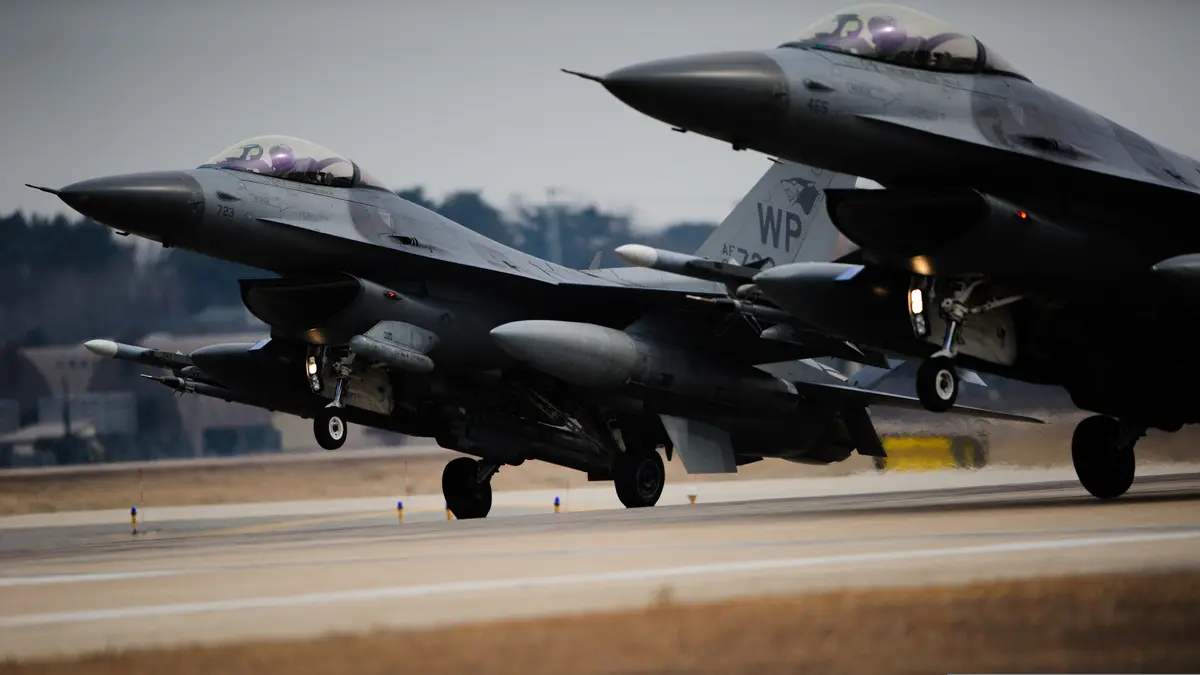
The United States Air Force has begun a major reorganization of its strategic air assets on the Korean Peninsula, moving 31 F-16 Fighting Falcons and approximately 1,000 airmen from Kunsan Air Base to Osan Air Base. The move establishes the service’s second operational “super squadron,” part of a strategic experiment aimed at increasing sortie generation, combat effectiveness and deterrence posture in one of the most volatile regions on Earth.
The move follows a smaller-scale phase that began in 2024, which involved moving nine aircraft and 150 personnel to Osan. The success of that test has led to this full-scale expansion, signaling a potential shift in the makeup of U.S. forward-deployed air power in the Indo-Pacific.

- 35th Fighter Squadron F-16 Fighting Falcons depart for Beverly Bulldog sortie at Kunsan Air Base, South Korea. (USAF)
What is a Super Squadron?
A “super squadron” is an organizational concept designed to concentrate more aircraft and personnel under unified command than traditional U.S. Air Force fighter units. While a standard fighter squadron typically has 18 to 24 jets, a super squadron consolidates more than 30 aircraft – along with extensive maintenance, logistics, and operational support teams – into a single integrated unit.
The goal is to streamline operations, increase mission flexibility, and maximize the sortie rate and readiness of available platforms. The Super Squadron at Osan is a practical implementation of the Air Force’s Agile Combat Employment (ACE) doctrine, which provides forward presence, rapid deployment, and decentralized command to counter adversary threats.
Strategic Case for Relocation
Located just 80 miles from the Demilitarized Zone (DMZ), Osan Air Base offers proximity that reduces flight times to potential hotspots in the event of hostilities. This allows the F-16s to respond quickly to airspace intrusions, missile launches, or other provocations from North Korea. “The combination of more aircraft and personnel at Osan allows us to deploy more combat power more efficiently,” said Col. Ryan, commander of the 51st Fighter Wing. Lay emphasized. “This change also deepens interoperability with the Republic of Korea Air Force (ROKAF) and enhances US-ROK joint readiness. The concentrated presence of fighters in a single forward location is expected to improve joint training, rapid mission planning, and coordinated responses.
- F-16 Fighting Falcons taxi on ‘Elephant Walk’ at Kunsan Air Base, South Korea. The demonstration demonstrated the combined strength and readiness of the U.S. and South Korean air forces.
(USAF)
Operational Advantages and Strategic Tradeoffs
Advantages:
- Increased Efficiency: Larger squadrons simplify logistics and streamline maintenance schedules, improving combat sortie availability.
- Rapid Response Time: Forward placement at Osan ensures faster time to target potential flashpoints on the peninsula.
- Enhanced Interoperability: Physical proximity and shared operational infrastructure improve integration with allied forces, particularly the ROKAF.
Risks:
- Concentration of Assets: Consolidating aircraft in a single location increases vulnerability to ballistic or cruise missile attacks, a known concern given North Korea’s missile capabilities.
- Infrastructure Stress: Osan’s base facilities — including flightlines, hangar space and housing — are being tested under increased operational loads.
- Reduced Redundancy: Moving away from dispersed basing reduces options for fallback or distributed operations in high-threat environments.
The Air Force emphasizes that this is a year-long test program. Commanders and analysts are closely monitoring the impact on mission output, force protection and base sustainability. “It’s testing whether a larger, more integrated squadron can produce more combat,” noted Capt. Bryce Hughes, 51st Maintenance Group. “Operating more efficiently and effectively” is the focus of this force structure assessment.
F-16 Fighting Falcon: A Proven Combat Asset
Decades after its initial deployment, the F-16 remains one of the most versatile and widely deployed multi-role fighters in the U.S. inventory. The jets deployed in Osan are advanced Block 40 and 50/52 variants, equipped with precision-guided munitions, upgraded electronic warfare suites, and advanced radar systems.
The F-16’s combat versatility allows it to easily execute a variety of missions, from air superiority and defensive counter-air to suppression of enemy air defenses (SEAD) and close air support. Its ability to remain effective in both contested and permissive environments has helped justify its central role in this new deployment model.
As the Air Force continues to integrate fifth-generation platforms like the F-35, the F-16’s relatively low cost, proven reliability, and ease of integration with allied forces make it an ideal platform for future operations in the allied arena.
- An Airman guides a missile toward an F-16 Fighting Falcon while another operates a bomb lift truck during Exercise Beverly Midnight 13-1 at Kunsan Air Base, South Korea. The crew worked quickly to prepare the F-16 for combat readiness. (USAF)
Blueprint for the Indo-Pacific?
This reorganization could signal future widespread deployments in the Indo-Pacific, particularly in the areas around Taiwan and at U.S. bases in Japan, Guam, and the Philippines. If successful, the Super Squadron model could be adopted for use with new platforms, such as the F-35A and upcoming sixth-generation aircraft under the NGAD program.
The outcome of this pilot program will shape the U.S. Air Force’s approach in the future, where speed of response, force flexibility, and resilience against missile threats are paramount. The move also signals America’s strong commitment to regional security at a time when tensions are high due to North Korea’s nuclear ambitions, China’s maritime assertiveness, and broader geopolitical instability.
Conclusion
The integration of 31 F-16s into a second “super squadron” at Osan Air Base is more than just a force movement—it is a strategic experiment in modern airpower projection. By balancing efficiency and vulnerability, this initiative provides important insights into how the United States can adapt its military presence in the Indo-Pacific to meet evolving threats. Today, the F-16 is not just a symbol of enduring capability, but plays a critical role in America’s forward defense of the Korean Peninsula.
Read More: China Unveils “Lunar Brick” Breakthrough, Accelerating Plans for Moon-Based Construction
FAQs: Questions & Answers
The move is part of a test of a concept called “Super Squadron.” By placing 31 F-16s and about 1,000 airmen at Osan, the Air Force wants to respond more quickly to threats from North Korea, train more closely with the South Korean Air Force, and improve overall combat readiness. The change also reflects America’s strategy to remain strong in the Indo-Pacific region, especially as tensions rise on the Korean Peninsula and near Taiwan.
A super squadron is a combination of more aircraft and airmen than usual that are combined into a larger unit. A regular squadron has about 18-24 jets, but a super squadron has 30+ fighter jets with full support crews. It’s trending right now because it shows how the U.S. is tackling new threats with a focus on faster missions, stronger joint training with allies, and higher sortie rates. Analysts are calling it a potential blueprint for future deployments across Asia, including places like Japan, Guam, and the Philippines.
Both. Having more F-16s in one place in Osan means faster operations and easier training with allies. But it also makes the base a bigger target for North Korea’s missile program, which has been in the news a lot with its frequent missile tests. That’s why this is being seen as an experiment — the Air Force is testing whether the efficiency benefits outweigh the risks of being an easy target.


Leave a Reply